
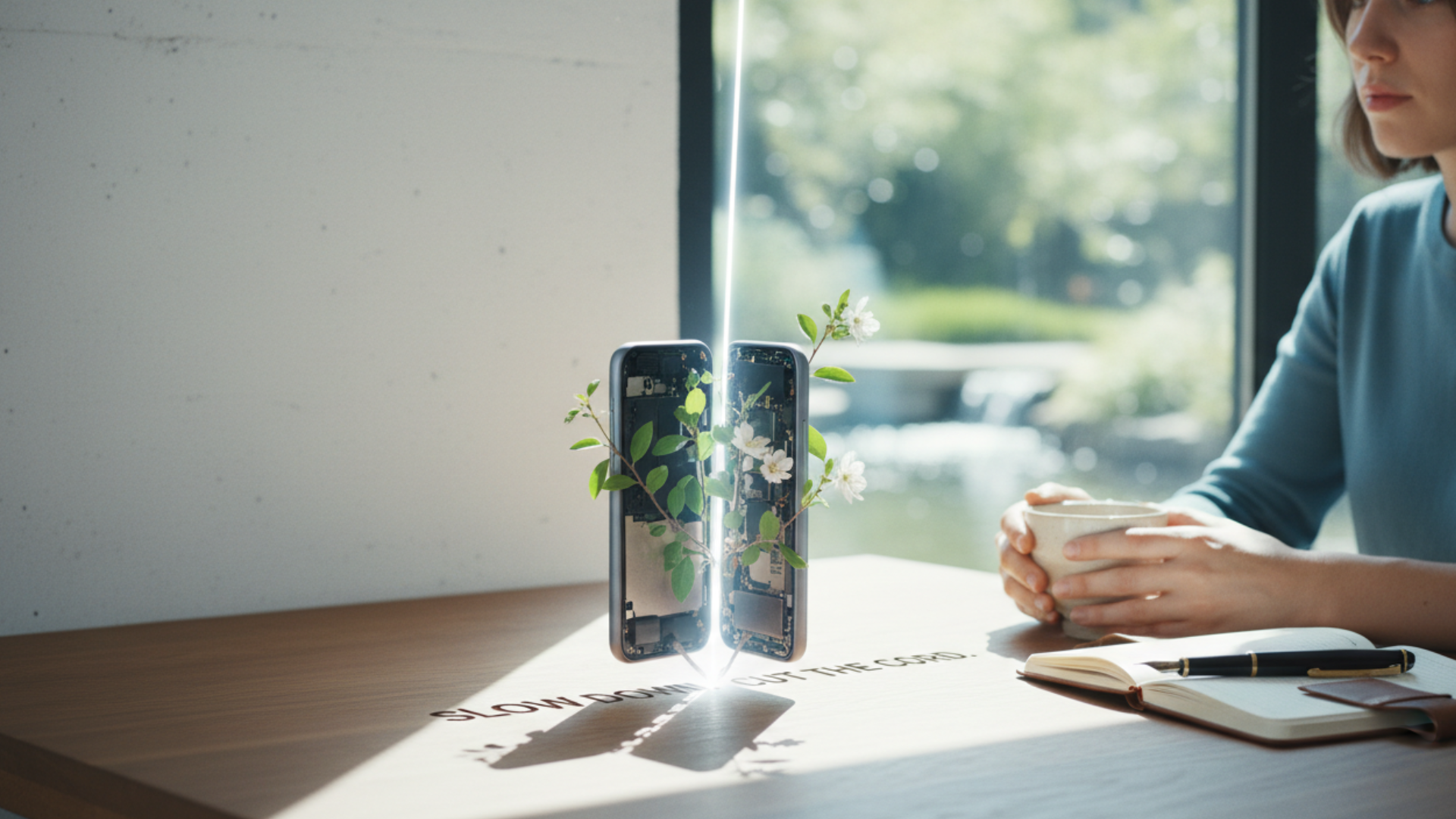
At the end of a long day, most of us do the same thing.
We sit down.
We reach for our phone.
We scroll.
It feels harmless. A few minutes to unwind. But those few minutes turn into forty-five. Then an hour. And somehow we go to bed feeling more restless than relaxed.
If your evenings feel noisy instead of restorative, you’re not alone. The good news is this: slowing down doesn’t require a dramatic lifestyle change. It requires a better transition.
Here’s how to create an evening rhythm that actually helps you rest — without defaulting to your phone.
1. Create a Clear “End of Day” Line
One reason we reach for our phones is because the day never clearly ends.
Work bleeds into dinner. Notifications interrupt conversations. Emails linger in the background. Without a boundary, your brain never gets the signal that it’s safe to relax.
Create a small ritual that marks the end of your day:
-
Close your laptop and physically move it out of sight
-
Turn off work notifications after a set time
-
Write down tomorrow’s top three tasks
-
Light a candle or dim the lights
This simple shift tells your nervous system, “We’re done for today.”
Slowing down begins with intention, not willpower.
2. Replace the Scroll, Don’t Just Remove It
If you simply say, “I won’t use my phone tonight,” you’ll feel the urge even more.
Instead, replace it.
Your brain is looking for stimulation and relief. Give it something better.
Try:
-
Reading something tangible
-
Listening to soft music
-
Making tea and sitting in quiet
-
Opening a physical letter instead of a digital feed
This is why story letters have become such a powerful evening ritual for many readers. They offer narrative and immersion without the constant pull of notifications. Unlike scrolling, stories told through letters unfold slowly. They require attention, and in return, they give depth.
The experience feels restorative rather than draining.
3. Change the Physical Environment
Environment shapes behavior more than discipline does.
If your phone is beside you on the couch, you will reach for it. If it’s in another room charging, you probably won’t.
Small adjustments make a big difference:
-
Charge your phone outside the bedroom
-
Keep a book or story letter on your coffee table
-
Use warm lamps instead of bright overhead lighting
-
Keep a blanket or reading chair ready
When your space signals calm, your habits follow.
Even something as simple as placing a letter on your table creates anticipation. That’s one reason a story letter subscription works so well as an evening ritual. The arrival of something physical gives you something to look forward to that isn’t screen-based.
Anticipation slows you down naturally.
4. Build a 20-Minute Wind-Down Routine
You don’t need an elaborate self-care plan. You need consistency.
A 20-minute wind-down routine could look like this:
5 minutes — Make tea or pour water
5 minutes — Light reading or reflection
10 minutes — Read something immersive, such as stories told through letters
The key is repetition. When your brain begins to associate this pattern with sleep and calm, the craving to scroll weakens.
Scrolling stimulates. Letters settle.
There is something grounding about holding paper in your hands. Your senses engage differently. You turn pages instead of swiping. You pause instead of refresh.
That shift alone can change how your evenings feel.
5. Choose Depth Over Volume
Most digital content is designed for speed and quantity. You consume hundreds of fragments. Few stay with you.
Slowing down at night is about choosing depth over volume.
Instead of fifty short inputs, choose one meaningful one.
Instead of quick headlines, choose a narrative.
Instead of noise, choose a voice.
This is where story letters shine. They give you a contained, intentional experience. One letter. One voice. One story at a time.
When stories are told through letters, they naturally create intimacy. You feel as though someone is speaking directly to you. That focus brings calm in a way scattered content cannot.
6. Protect the Last Hour Before Sleep
The final hour of your day shapes your sleep and your mood the next morning.
Blue light suppresses melatonin. Notifications spike cortisol. Endless scrolling keeps your mind in a reactive state.
If you protect just one hour, protect the last one.
Set a digital sunset time. Even 30 minutes phone-free before bed can improve sleep quality and mental clarity.
Replace that time with something analog:
-
Journaling
-
Reading physical books
-
Reviewing a letter you received
-
Sitting in silence
A story letter subscription can become part of that protected hour. Instead of random inputs, you receive a deliberate, unfolding narrative. That rhythm feels slower and more human.
And human rhythms restore us.
7. Make It Something You Look Forward To
The biggest mistake people make when trying to reduce screen time is framing it as restriction.
Slowing down works best when it feels like a reward.
If your evenings feel empty without your phone, you haven’t replaced the experience, you’ve removed it.
Instead, build something you anticipate:
-
A monthly delivery
-
A reading ritual
-
A cozy chair that becomes your “quiet place”
-
A weekly night dedicated to immersion in stories told through letters
Anticipation changes everything. When you look forward to something tangible arriving in your mailbox, the habit of checking your phone loses its grip.
A Different Kind of Ending
The end of your day should not feel like mental clutter.
It should feel like a gentle closing.
Phones are not the enemy. But unconscious habits are. When every evening ends in scrolling, you lose the chance to reflect, imagine, or truly rest.
Slowing down is not about doing less. It’s about choosing better inputs.
Choose something you can hold.
Choose something that unfolds slowly.
Choose something that lingers.
When you replace noise with narrative, distraction with depth, and scrolling with story letters, your evenings begin to feel different.
And sometimes, a different ending is exactly what the day needed.